195  uoco

195.0.0.1 bases lexicais

id: http://lila-erc.eu/data/id/lemma/130729
classe: verbo
paradigma: 1ª conjugação (tema em -ā-)
outras grafias:
variantes do lema:

uoco presente | indicativo | 1ª pessoa singular | voz ativa
uocare presente | infinitivo | ativo
uocabit futuro | indicativo | 3ª pessoa singular | voz ativa
uocaui pretérito perfeito | indicativo | 1ª pessoa singular | voz ativa
uocatum, uocitum particípio passado | nominativo neutro singular
uocaturum particípio futuro | nominativo neutro singular

vŏcō
vocās
vocāre
vocāvī
vocātum

195.0.0.2 dicionários tradicionais

vocō -ās -āre -āvī, -ātum
v. tr.

1I-Sent. próprio   Chamar, mandar vir   Cés. B. Gal. 1, 20. 6; Verg. En. 7. 614.
2I-Daí:   Convocar   T. Lív. 23. 32,3; Cíc. Ac. 2. 144.
3I-Donde:   Nomear, pronunciar o nome de alguém, designar   Cíc. Leg. 1, 22; Cíc. Val. 29; Verg. En. 6, 247; Verg. G: 1. 157.
4II-Sent. figurado:   Convidar   Cic. Mur. 72; Cíc. Mur. 71.
5II-Donde:   Exortar, incitar   Cíc. At. 3. 15. 6.
6II-Na língua jurídica:   Intimar, citar, fazer vir, processar   Cíc. Quinct. 61; Cíc. Verr. 2, 34.
7II-Na língua militar:   Provocar   Cés. B. Gal. 5. 43. 6; Tác. Germ. 14.
8II-Na língua militar:   Causar, suscitar   Cíc. At. 3, 7. 2; Cíc. Verr. 5. 10.
9II-Na língua militar:   Destinar a, levar a   Cíc. Cal. 1. 12.

no data

Voco -as -avi -atum -are

1Cic.   chamar.
2   nomear, pôr hum nome.
3Virg.   invocar.
4Tac.   provocar, desafiar.
5Cic.   attrahir, convidar.

[EXEMPLOS]

X
uocare a maestitia   CicProcurar que alguem se alegre
uocare ad computationem   Plin. JunFazer, dar contas a alguem
uocare aliquem ad calculos   CicFazer, dar contas a alguem
uocare in inuidiam   CicExcitar a inveja contra alguem
uocare in partem alicuius rei   VirgFazer alguem participante de alguma cousa
uocare in suspicionem   CicMetter em suspeita

no data

Voco -as

1   chamar

195.0.0.3 dados de corpus

This chart plots collocate by scoreSUBST, for the headword uoco here are all the values plotted: collocate: iudicium; scoreSUBST: 3. collocate: iubeo; scoreSUBST: 0. collocate: sui; scoreSUBST: 0

This chart plots collocate by scoreADJ, for the headword uoco here are all the values plotted: collocate: iudicium; scoreADJ: 0. collocate: iubeo; scoreADJ: 0. collocate: sui; scoreADJ: 0

This chart plots collocate by scoreVERBO, for the headword uoco here are all the values plotted: collocate: iudicium; scoreVERBO: 0. collocate: iubeo; scoreVERBO: 2. collocate: sui; scoreVERBO: 0

This chart plots collocate by scoreADV, for the headword uoco here are all the values plotted: collocate: iudicium; scoreADV: 0. collocate: iubeo; scoreADV: 0. collocate: sui; scoreADV: 0

This chart plots collocate by scoreFUNC, for the headword uoco here are all the values plotted: collocate: iudicium; scoreFUNC: 0. collocate: iubeo; scoreFUNC: 0. collocate: sui; scoreFUNC: 0

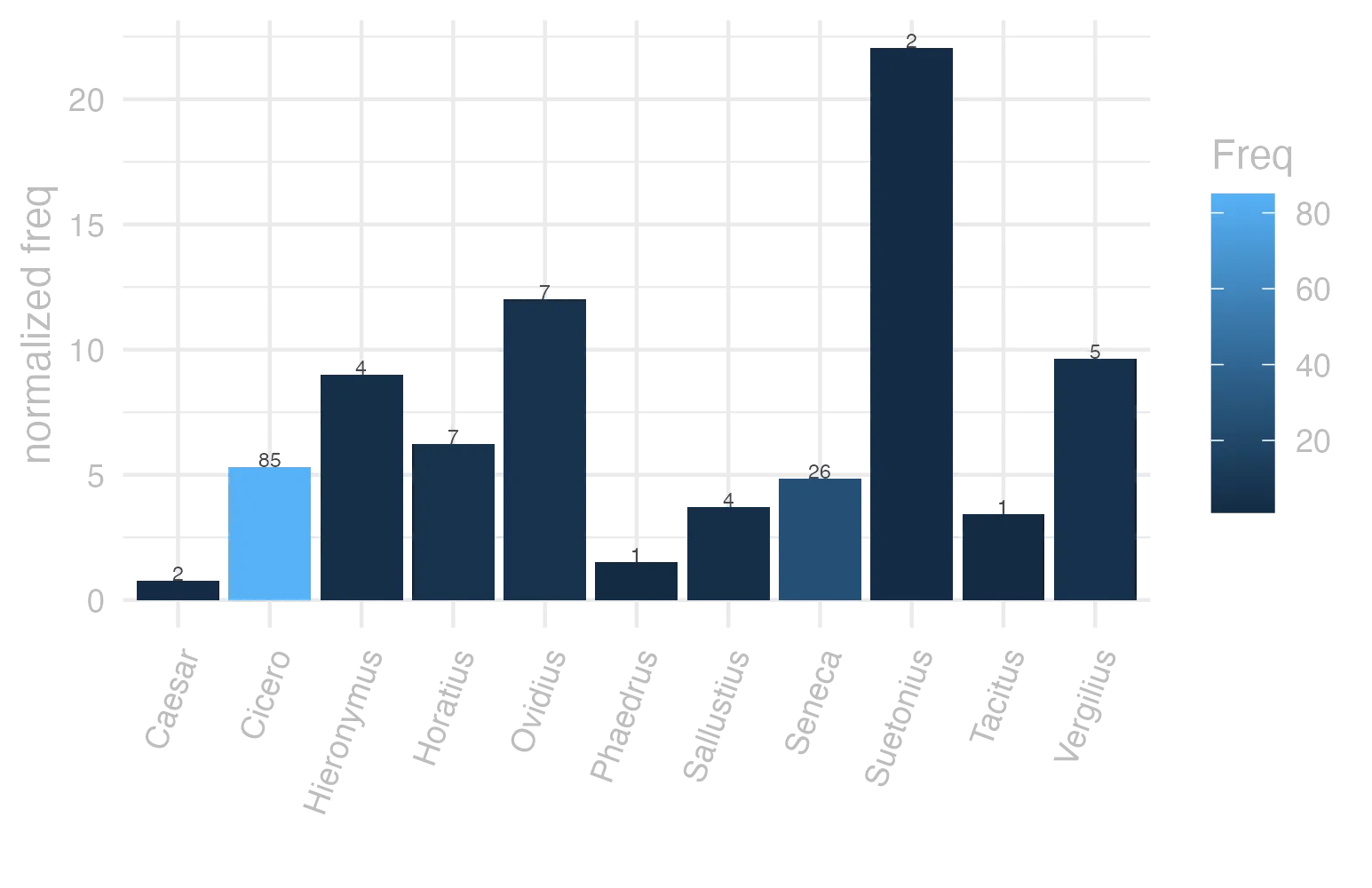
This charts plots the frequency of lemma by author_Frequencies. The Suetonius subcorpus registers the highest normalized frequency, with the value of 22.05 and an absolute frequency of 2. The Ovidius subcorpus follows, with a normalized frequency of 12.01 and an absolute frequency of 7. the subcorpus with the least normalized frequency is Caesar with the normalized value of 0.76 and an absolute freqeuncy of 2. here are all the values: subcorpus: Caesar ; normalized frequency: 2 ; absolute frequency: 0.755344059218974. subcorpus: Cicero ; normalized frequency: 85 ; absolute frequency: 5.29515835638285. subcorpus: Horatius ; normalized frequency: 7 ; absolute frequency: 6.21614421454578. subcorpus: Ovidius ; normalized frequency: 7 ; absolute frequency: 12.0109814687714. subcorpus: Phaedrus ; normalized frequency: 1 ; absolute frequency: 1.5181417944436. subcorpus: Sallustius ; normalized frequency: 4 ; absolute frequency: 3.71023096187738. subcorpus: Seneca ; normalized frequency: 26 ; absolute frequency: 4.8524663593438. subcorpus: Suetonius ; normalized frequency: 2 ; absolute frequency: 22.0507166482911. subcorpus: Tacitus ; normalized frequency: 1 ; absolute frequency: 3.43288705801579. subcorpus: Vergilius ; normalized frequency: 5 ; absolute frequency: 9.65250965250965. subcorpus: Hieronymus ; normalized frequency: 4 ; absolute frequency: 8.98674455178612

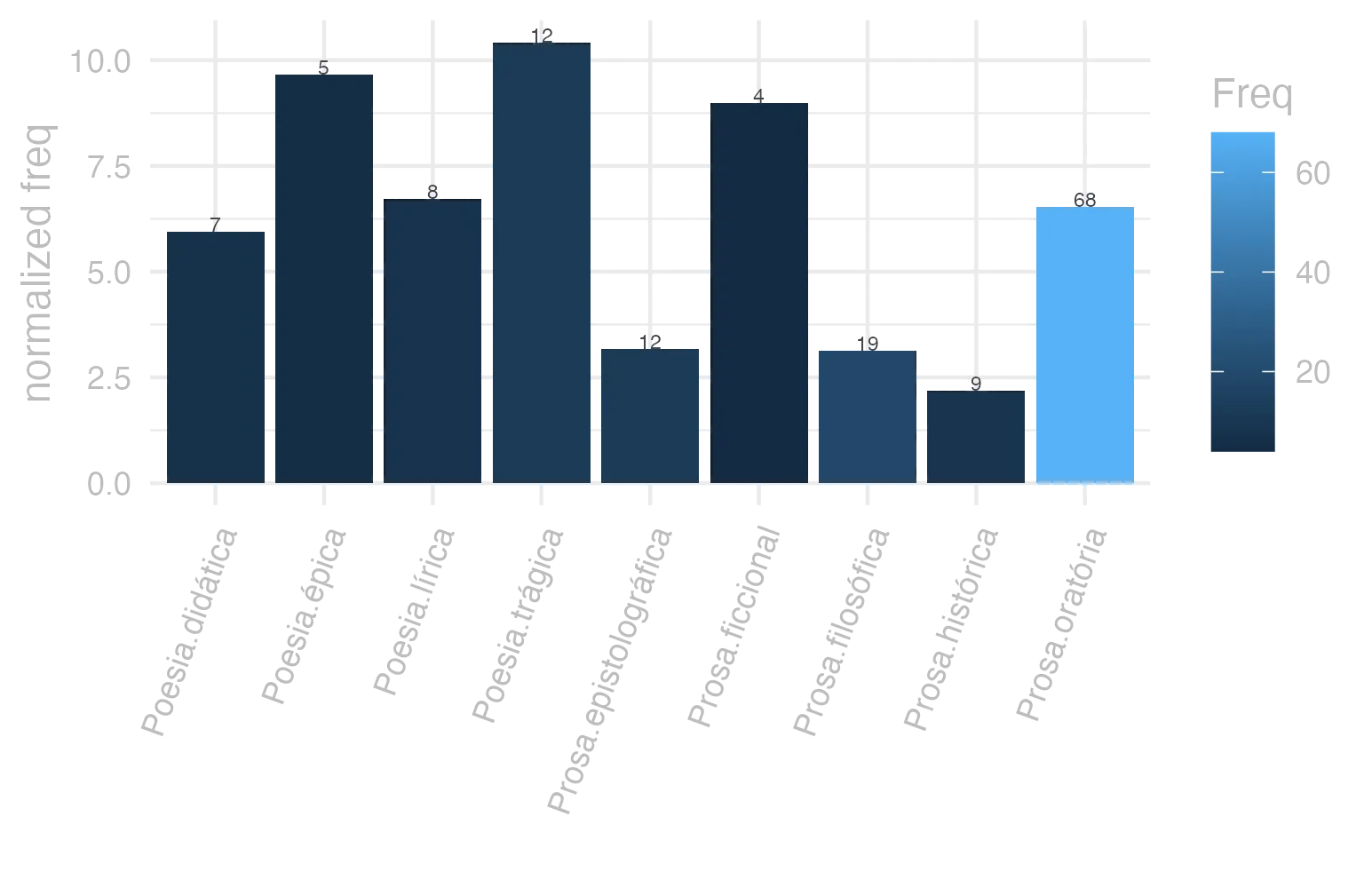
This charts plots the frequency of lemma by genre_Frequencies. The Poesia.trágica subcorpus registers the highest normalized frequency, with the value of 10.42 and an absolute frequency of 12. The Poesia.trágica subcorpus follows, with a normalized frequency of 10.42 and an absolute frequency of 12. the subcorpus with the least normalized frequency is Prosa.histórica with the normalized value of 2.19 and an absolute freqeuncy of 9. here are all the values: subcorpus: Prosa.histórica ; normalized frequency: 9 ; absolute frequency: 2.1909004600891. subcorpus: Prosa.filosófica ; normalized frequency: 19 ; absolute frequency: 3.13009670351395. subcorpus: Prosa.oratória ; normalized frequency: 68 ; absolute frequency: 6.52885658598408. subcorpus: Prosa.epistolográfica ; normalized frequency: 12 ; absolute frequency: 3.1797344921699. subcorpus: Poesia.lírica ; normalized frequency: 8 ; absolute frequency: 6.73004122150248. subcorpus: Poesia.didática ; normalized frequency: 7 ; absolute frequency: 5.93773856985325. subcorpus: Poesia.trágica ; normalized frequency: 12 ; absolute frequency: 10.4239054899236. subcorpus: Poesia.épica ; normalized frequency: 5 ; absolute frequency: 9.65250965250965. subcorpus: Prosa.ficcional ; normalized frequency: 4 ; absolute frequency: 8.98674455178612

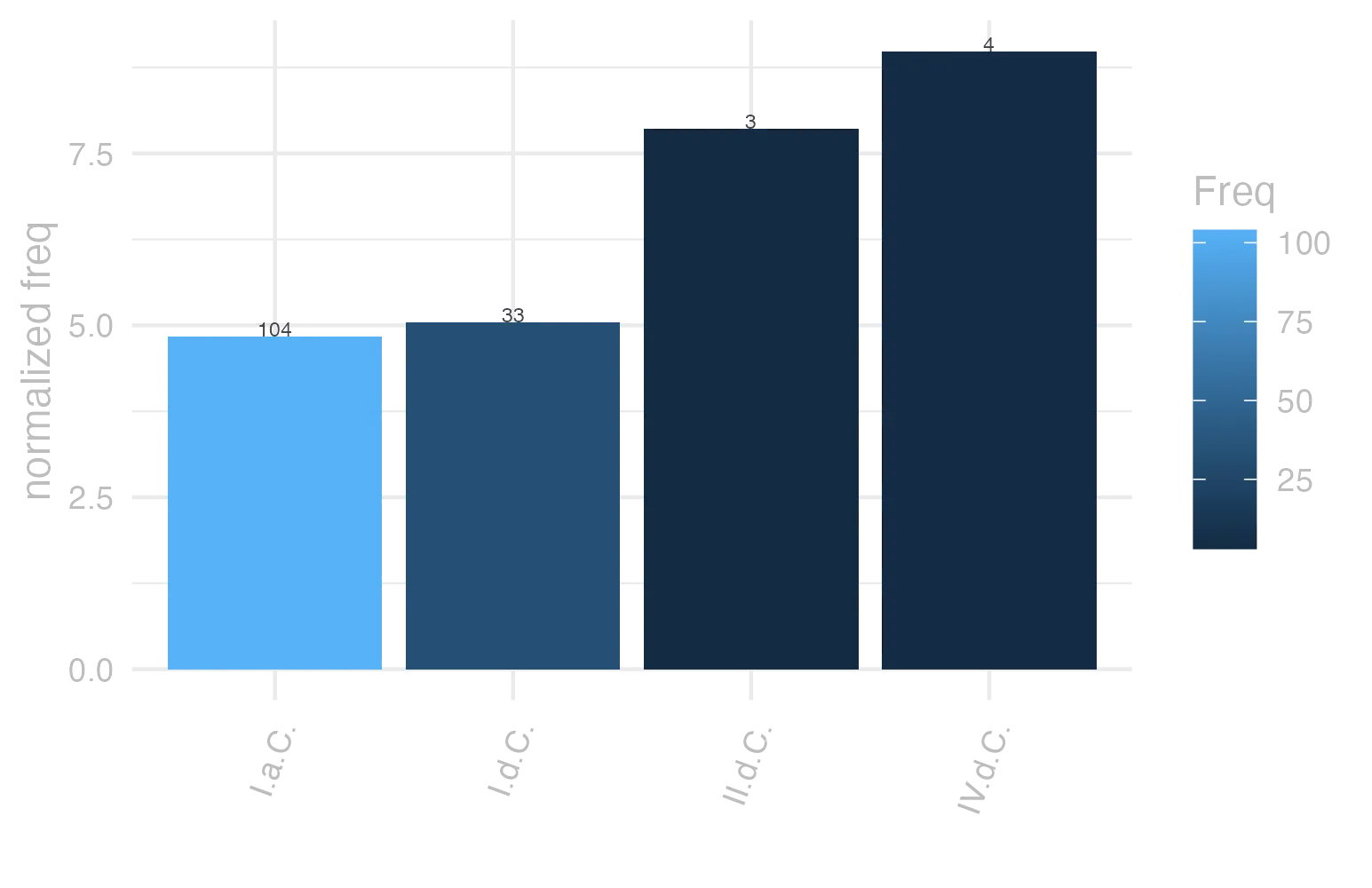
This charts plots the frequency of lemma by period_Frequencies. The IV.d.C. subcorpus registers the highest normalized frequency, with the value of 8.99 and an absolute frequency of 4. The II.d.C. subcorpus follows, with a normalized frequency of 7.85 and an absolute frequency of 3. the subcorpus with the least normalized frequency is I.a.C. with the normalized value of 4.84 and an absolute freqeuncy of 104. here are all the values: subcorpus: I.a.C. ; normalized frequency: 104 ; absolute frequency: 4.84058645566674. subcorpus: I.d.C. ; normalized frequency: 33 ; absolute frequency: 5.04818724185406. subcorpus: II.d.C. ; normalized frequency: 3 ; absolute frequency: 7.85340314136126. subcorpus: IV.d.C. ; normalized frequency: 4 ; absolute frequency: 8.98674455178612

amicum enim nostrum in iudicium uocabas
Cic.Ver.2.4.25.19
“Pois chamavas a julgamento um amigo nosso.” [JDD]

armis enim gesta numquam profecto in iudicium uocabuntur
Cic.Phil.1.21.6
Pois as coisas feitas pelas armas nunca, sem dúvida, serão chamadas em juízo. [JDD]

M. uero Caelius cur in hoc iudicium uocatur
Cic.Cael.72
Por que, porém, Marco Célio é citado para este julgamento? [JDD]

quidam ita finiunt bonum est quod inuitat animos quod ad se uocat
Sen.Ep.118.8
Certos o definem assim: “O bem é o que convida os espíritos, o que os chama para si”. [JDD]

tum se Milo continuit et P. Clodium in iudicium bis ad uim numquam uocauit
Cic.Mil.40
Então Milão se conteve e chamou duas veze Públio Clódio a julgamento, nunca à violência. [JDD]

an hic si sese isti uitae dedidisset consularem hominem admodum adulescens in iudicium uocauisset
Cic.Cael.47
Por acaso este, se tivesse se dedicado a essa vida, teria, ainda muito jovem, chamado em juízo um ex-cônsul? [JDD]

igitur confirmato animo uocari ad sese iubet Lentulum Cethegum Statilium Gabinium itemque Caeparium Terracinensem qui in Apuliam ad concitanda seruitia proficisci parabat
Sal.Cat.46.3
Então, com seu espírito restabelecido, ordena que sejam chamados até ele Lêntulo, Cetego, Estatílio, Gabínio e também Cepário de Tarracina. Este se dispunha a partir para Apúlia para sublevar os escravos. [JDD]

195.0.0.4 Diagrama de Zipf
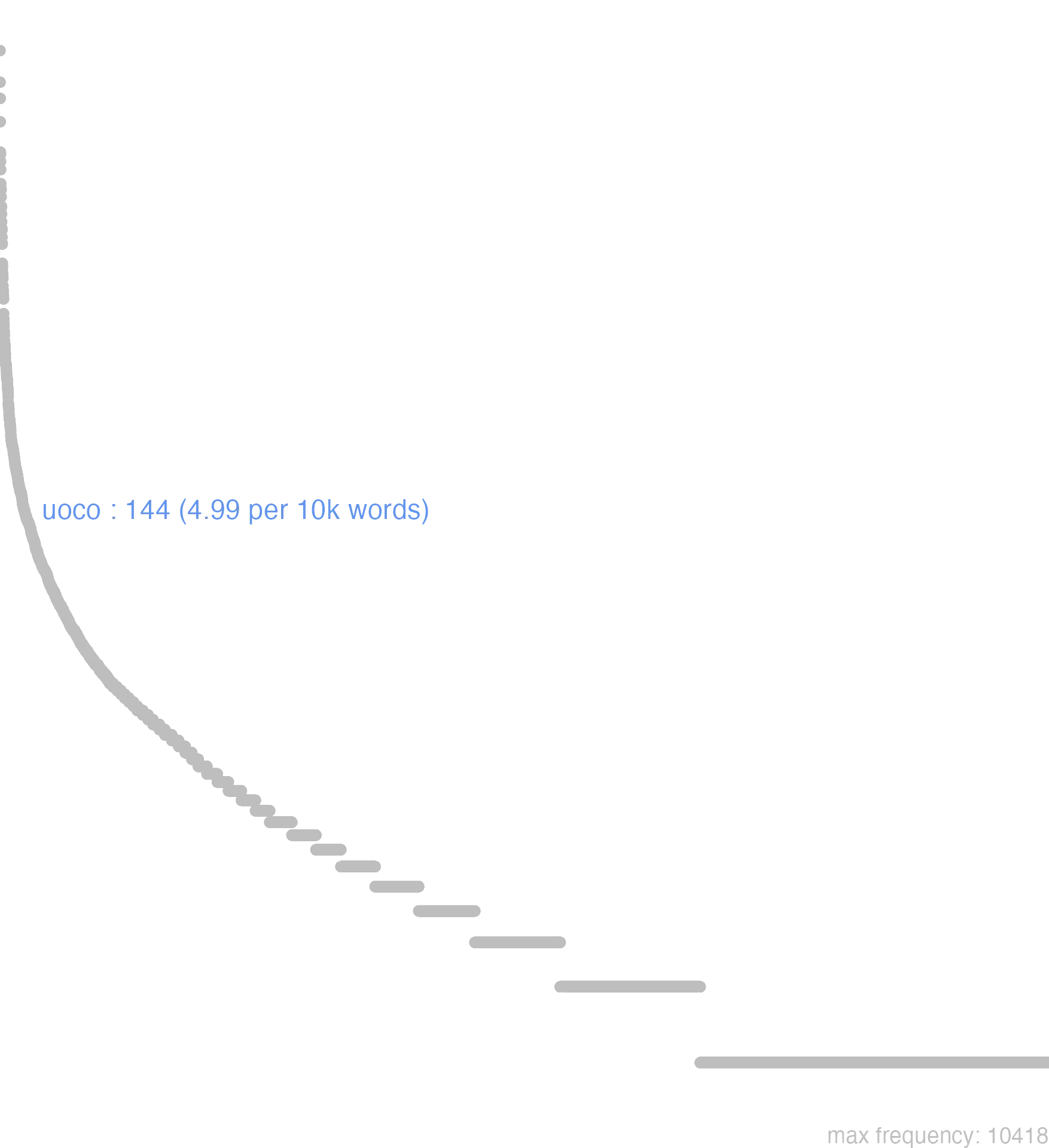
this chart shows that the frequency of uoco is 144 or, 4.99 per 10000 words. By frequency, uoco ranks 286th out of 11113